Numerical Evaluation of BCS Superfluid Stiffness
(unpublished)
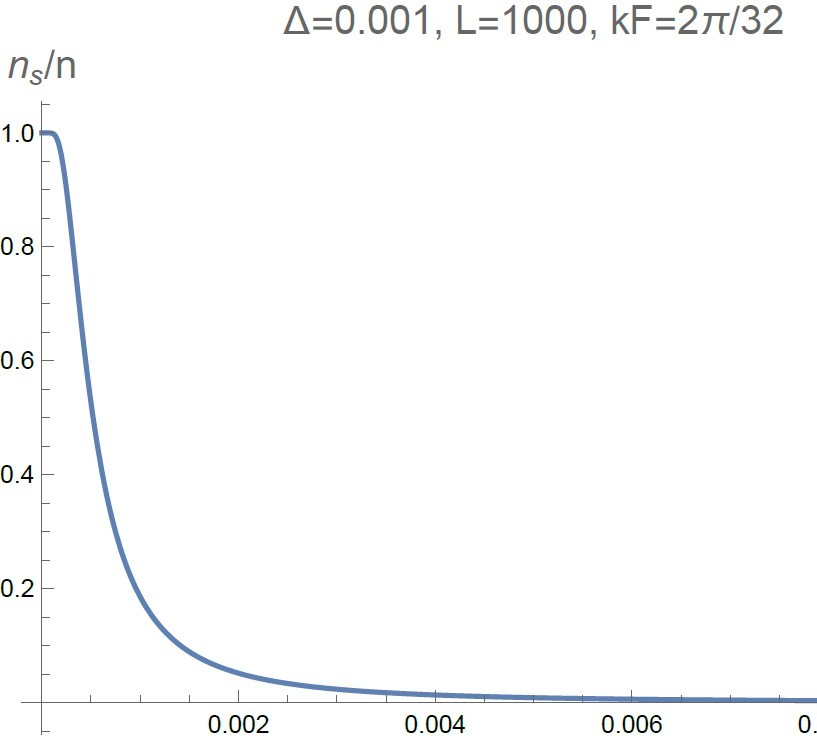
- This was my first simple project as a graduate student, and was devised by my advisor to help me gain familiarity with field-theoretic approaches to BCS superconductivity and numerical approaches to continuum systems.
- Using a 2d tight-binding dispersion and chemical potential chosen to approximate a continuum model, I introduce a gauge field via a Peierl's substitution and utilize the resulting interaction vertices to determine (numerically) the diamagnetic and paramagnetic response diagrams. The numerics were performed using Mathematica.
- I then construct the sum of these two responses, known as the superfluid density, and plot it in units of the electron density. At low-T the superfluid density approaches the total electron density, and at high-T it decays to zero -- signifying the normal state regime. I also compare my result with the theoretical prediction provided in Altland and Simon's textbook, and find a close agreement.
- Please see the attached PDF below for details of the analysis.